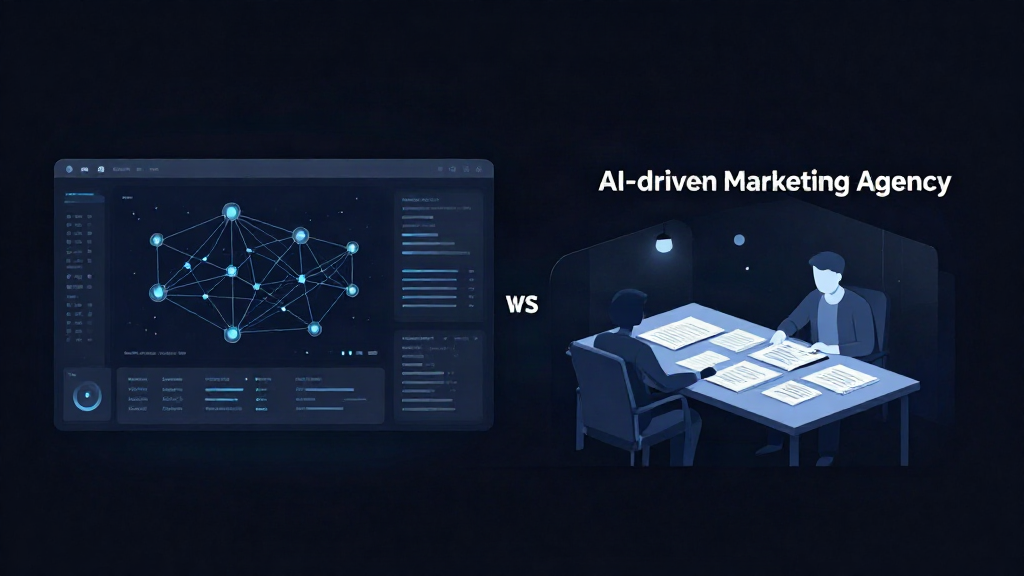
If you run a small or mid-sized business in Albania, Kosovo or North Macedonia, you will eventually face the same question: do you hire a traditional marketing agency on a monthly retainer, or do you run an AI marketing platform you actually control? The AI marketing platform vs marketing agency debate usually turns into a fight about tools. That is the wrong fight. The real question is which model brings you concrete enquiries, and who stays responsible when they do not.
We built Global Marketing AL because we kept seeing the same pattern. A business signs a retainer, pays every month, gets a deck of pretty slides, and still cannot name a single new customer that came from the work. So let us compare the two models honestly, including where each one loses.
How a traditional agency retainer actually works
A traditional agency sells you time. You pay a fixed monthly fee, and in exchange a team handles your campaigns, your content and your reporting. On paper, that sounds like relief. In practice, you are buying capacity you cannot see and results you cannot measure until the invoice is already paid.
The model has real strengths. You get experienced people, an external point of view, and someone else doing the execution. When the retainer is well matched to your goals, an agency can move faster than a team you would have to hire and train yourself. For a company with no marketing staff at all, that support genuinely matters.
The weaknesses are structural, not personal. The agency controls the strategy and the numbers. You receive reports on their schedule, framed the way they choose. When something underperforms, the answer is usually more budget or more time, rarely a straight explanation. And because the retainer is billed whether or not leads arrive, the incentive is to keep the relationship running, not to prove a return.
How an AI-driven marketing platform actually works
A platform model flips who holds the controls. Instead of renting a team by the month, you use a system that connects your CRM, your website, your business processes and your ad campaigns into one place. The AI does the repetitive work: it tracks where enquiries come from, flags which campaigns produce them, and keeps the pipeline visible to you in real time.
You still need people, but they build and configure the system instead of billing you forever for its operation. That changes the economics. You are not paying for hours logged; you are paying for a machine that keeps working after the setup is done. This is what we mean when we call our product an AI-driven marketing control platform. The word that matters is control.
The trade-off is honest and worth stating. A platform asks you to engage with your own data. If you want to hand everything over and never look at a dashboard again, a platform will feel like work. If you want to know exactly which channel produced last week's enquiries, it is the only model that answers that question clearly.
Where each model wins
An agency wins when you need senior expertise on a problem you cannot yet define, when you need a burst of creative production, or when you simply have no internal capacity and no time to build any. It also wins when the relationship is genuinely transparent and the agency treats your money like its own.
A platform wins when your goal is measurable enquiries and predictable cost. It wins when you want the same system to own your CRM, your website and your campaigns, so that a lead is never lost between tools. It wins when you have a real pipeline and you want to see, not guess, what is working.
Where each model quietly costs you
The quiet cost of an agency is not the fee. It is the months that pass before anyone admits a channel is dead, and the knowledge that walks out of the door when the account manager changes. You can pay for a year and own nothing at the end of it, except a folder of reports.
The quiet cost of a platform is the setup discipline. Someone has to decide what counts as an enquiry, where leads should land, and who follows up. Skip that work and you get an expensive dashboard that nobody opens. Neither model saves you from clarity about your own business. Only one of them leaves you holding the asset when you are done.
A practical decision checklist
Before you choose, answer these questions in writing. Where do your enquiries currently come from, and can you prove it? Who owns the CRM, the website and the ads today, and who would own them in each model? How quickly do you want to see measurable results, and what will you do if a channel fails? What happens to the system, the data and the knowledge if you stop paying?
If you cannot answer those, no agency and no platform will fix it. If you can answer them, the choice usually becomes obvious. Businesses that want to own their pipeline and see their numbers lean toward a platform. Businesses that need hands on a problem today lean toward an agency, at least for a defined project.
How we approach it
At Global Marketing AL we build the system, not the retainer. We connect your CRM, your website, your business processes and your campaigns into one AI-driven platform, and we start every engagement with a conversation and a written quote. We do not publish prices because every business needs a different scope, and we do not publish invented numbers because they would not be true.
If you are weighing an AI marketing platform against a traditional agency, ask for the quote in writing and ask who owns the results. Then decide which model keeps you in control of your own enquiries.
The honest answer to AI marketing platform vs marketing agency is that the winning model is the one where you can see your own numbers and own your own pipeline. That is the standard we build to.